Death Valley National Park Pt. 1
- Macey VanDenMeerendonk
- Apr 7, 2022
- 3 min read

I left Mojave and headed for Death Valley National Park. I said goodbye to the large Joshua Tree forest and said hello to sandy multicolored mountains and a burning hot valley. I stopped at the Furnace Creek Visitors Center for a map and then figured out my game plan for my visit.
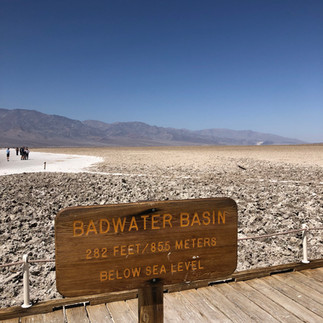
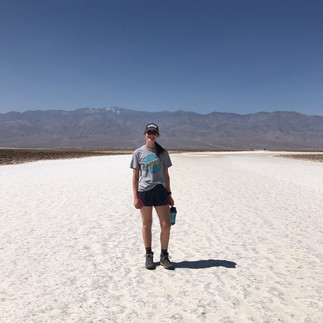
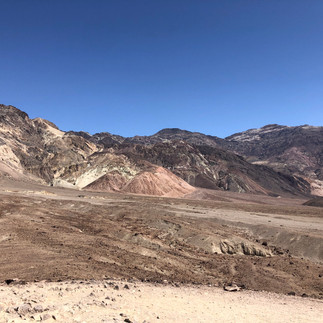
I headed to Badwater Basin Salt Flats and walked the area. The bright white salt on the ground illuminated the landscape and contrasted the brown ground underneath it and the mountains on both sides of the valley. Badwater Basin is 282 ft below sea level and is the lowest point in North America. The cliff edge across from the parking lot has a sign up high that showed sea level; it was cool to see how much further below the basin is. Next, I drove Artists Drive and made many stops to hop out to look around and take pictures. The multicolored hills were so cool, and the winding road through the oddly shaped hills made it even cooler.
I stopped at the Golden Canyon Trailhead and walked it for a little bit. The curvy trail showed many interesting jagged rock features and walls. The golden rock walls were so different from the Artists Drive just a few miles down the road. I decided to head back before I finished the hike because the heat was starting to get to me. Those were all the stops I had planned for the day so I made my way back to the visitors center to sit in some AC for a little bit. They had a historical movie playing in the auditorium and it was interesting to learn how Death Valley came to be and who called this place home before the world claimed it. The Timbisha Shoshone tribe, which still calls Death Valley home today, has been living on this land for centuries. What we know as a harsh, hot, and desolate landscape, they know as vibrant, spiritual, and home to animal and plant life. It was interesting to learn that Death Valley had an industrial history with the mining of borax, gold, silver, etc. The company Borax had mines in the valley until they realized they could make a profit in tourism as well. Eventually, the land became a national monument in 1933 and a national park in 1994.
The natural history was also very interesting. Two expanses of rock had moved, eventually separating, and their debris fell between them, creating the flat basin. The basin fills with water and then with the heat the water evaporates, leaving behind the salt flats. It is much more complex than that, but that's what I took away from the movie.
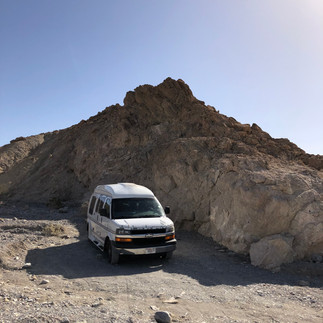
After the movie, I walked through the little exhibit they have at the visitors center. With a tiny bit of cell service, I found my campsite for the night and headed toward the dispersed site. On my way, I passed Zabriskie Point and made a quick stop to have a look. It was beautiful in all directions and looked different in all directions; interesting hills, red rock formations, and flatter lands. I then kept moving until I had to turn up a gravel road. I found a spot about a mile and a half up the road next to a large rock wall. I ate a very late lunch/early dinner and laid on the floor of my van with my vent fan on. I was so hot! I don't think I was made for 95-degree weather...









Comments